How does a battery “survive” a Siberian winter or a high-altitude drone mission? In the rechargeable lithium industry, the difference between a functional device and a bricked power pack often comes down to two acronyms: BMS (Battery Management System) and PCM (Protection Circuit Module). While both govern safety, their roles in wide-temperature applications—ranging from -40°C zu +80°C—are fundamentally different.
Can Standard Protection Survive Sub-Zero Charging?
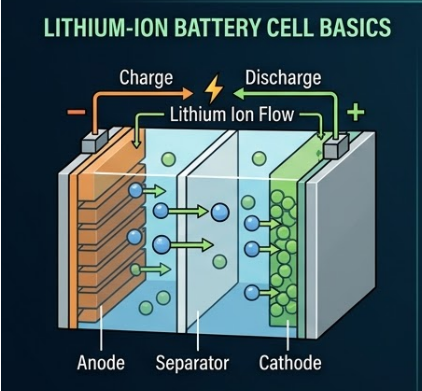
The primary threat to lithium-ion batteries in cold environments isn’t just power loss; it is Lithium Plating. When a cell is charged below $0°C, lithium ions fail to intercalate into the anode, instead forming metallic dendrites that can cause internal shorts.
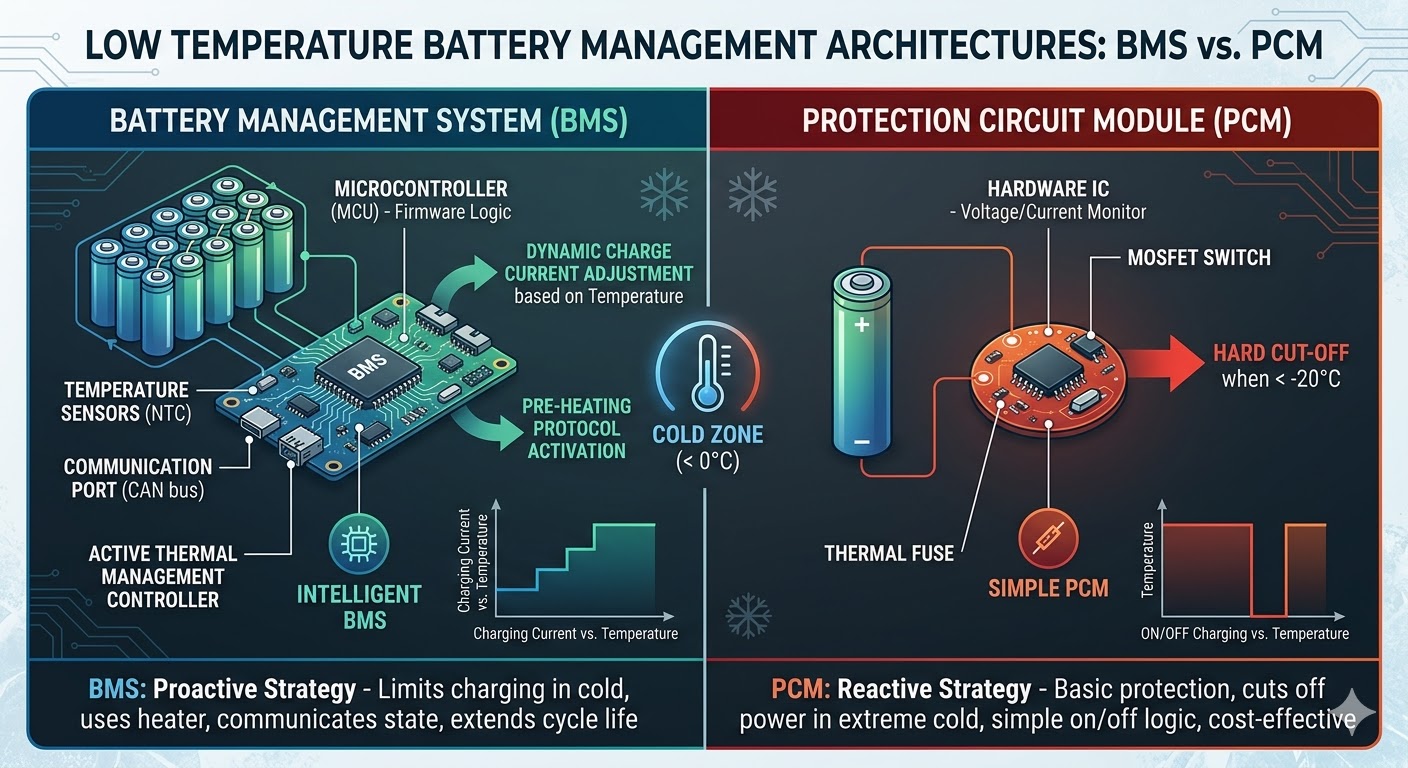
PCM (Protection Circuit Module) as a Static Shield. In most consumer-grade wide-temperature batteries, such as USB-rechargeable lithium AA/AAA cells, a PCM is the standard. It acts as a hardware-based gatekeeper. Its logic is binary: if the temperature sensor (NTC) hits a pre-set low limit, it cuts the circuit. While effective at preventing “catastrophic” failure, it is a blunt instrument. It cannot adjust the charging rate to accommodate the cold; it simply stops the show.
How Does a BMS Transform a Battery into an Intelligent System?
Why do industrial-grade wide-temperature packs cost significantly more? The answer lies in the BMS (Battery Management System). Unlike a PCM, a BMS is a microcomputer that manages the “health” of the battery through complex firmware.
BMS as an Active Thermal Manager. For high-stakes applications—telecom base stations, medical cold-chain trackers, or outdoor EV chargers—a BMS does more than watch the temperature. It initiates Pre-heating Protocols. By directing a portion of the incoming current to internal heating films, the BMS warms the cells to an optimal $+10°C$ before allowing the main charge to flow. This “active” intervention ensures the battery remains operational even when the external environment is frozen.
What Role Does Energy Density Play in Wide-Temperature Logic?
Does the choice of electronics change depending on the battery chemistry? Absolutely.
-
Rechargeable Lithium-Ion (Li-ion): High energy density but extremely sensitive to cold charging. Here, a BMS is preferred to manage the “Current vs. Temperature” curve dynamically.
-
Specialized Wide-Temp Cells: Some manufacturers use proprietary electrolytes that remain fluid at $-40°C$. In these cases, a high-quality PCM may suffice because the chemistry itself handles the physical stress, requiring less electronic “hand-holding.”
-
USB-Integrated Lithium: These are a marvel of miniaturization. Because there is no room for a full BMS, these rely on ultra-low-power PCMs that prioritize low quiescent current to prevent the battery from draining itself while sitting in a cold warehouse.
Which Architecture Best Fits Your Specific Application?
To choose between BMS and PCM, one must weigh the cost of the electronic components against the cost of system downtime.
| Anmeldung |
Recommended Logic |
Reason |
| Consumer USB Batteries |
PCM |
Compactness and cost-efficiency are paramount. |
| Outdoor IoT Sensors |
Advanced PCM / Lite BMS |
Requires long-term shelf life and basic low-temp cutoff. |
| Electric Vehicles / Marine |
Full BMS |
Safety, heating, and SOC accuracy are non-negotiable. |
| Medical/Military Gear |
Full BMS |
Redundancy and data logging (SOH) are required for mission success. |
Is Communication the Final Frontier for Battery Reliability?
How does the host device know the battery is struggling? This is the final advantage of a BMS over a PCM. While a PCM is “silent,” a BMS speaks via CAN bus, RS485, or SMBus. In a wide-temperature environment, the BMS can send a signal to a central controller: “I am too cold to charge; please activate external heaters or reduce load.” This level of integration is what separates professional energy solutions from hobbyist components.
Engineering for the Extremes
In the realm of wide-temperature rechargeable lithium batteries, the PCM provides the safety floor, while the BMS provides the performance ceiling. For simple, low-cost devices, a PCM-protected cell with cold-resistant electrolyte is often the smartest move. But for infrastructure that must breathe in the frost and sweat in the heat, an intelligent BMS is the only way to ensure that “wide-temperature” isn’t just a label, but a guarantee.
Tags:
# LithiumBattery
#LithiumBatteryPack
#BMSvsPCM
#LowTemperatureTech
#EnergyStorage
#IndustrialElectronics
##USBBattery
#