

Blog
Understanding the 18650 Cylindrical Lithium-Ion Cell Basics
Oct 09, 2026
Déposer une demande de consultation gratuite

With the rapid development of smart manufacturing, intelligent warehousing, and automated logistics, AGVs have become essential equipment in modern factories and distribution centers. Whether used for material transfer, production line delivery, or warehouse transportation, the operating efficiency of an AGV directly affects overall workflow and productivity.
In an AGV system, the battery is not just a power source. It is a key component that determines runtime, output stability, charging efficiency, maintenance cost, and long-term operational reliability. If the battery solution is not properly matched, the AGV may suffer from insufficient runtime, frequent downtime, long charging cycles, or unstable power output, all of which can reduce overall system efficiency.
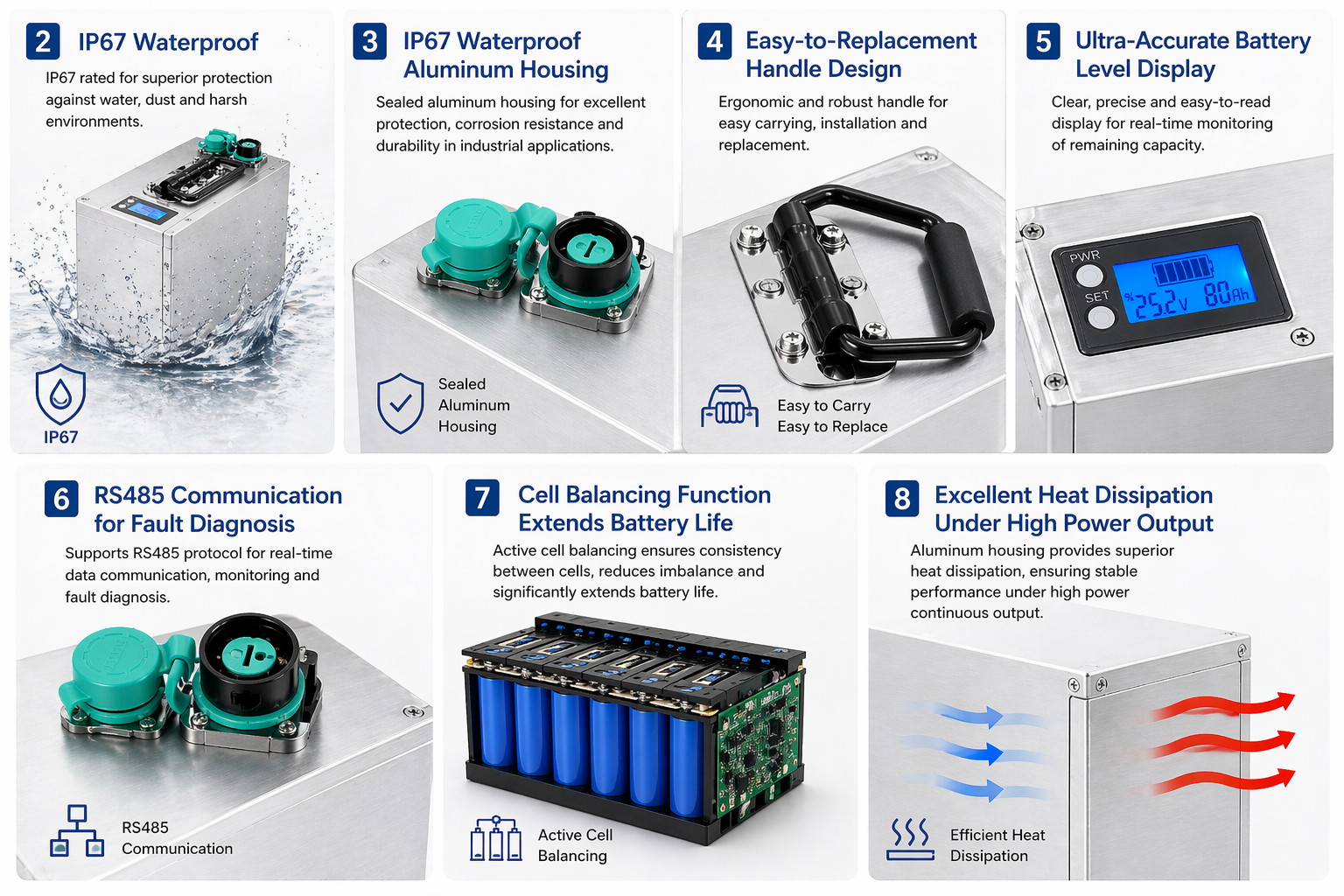
For this kind of application, the PKCELL 25.2V 80Ah lithium battery solution provides stable, efficient, and reliable power support for intelligent material handling equipment. The battery features an IP67 waterproof aluminum housing, supports 100A high-efficiency continuous discharge, and is equipped with an ultra-accurate battery level display, a handle design for easy replacement, and RS485 communication for battery monitoring and fault diagnosis. In addition, the aluminum housing not only offers strong mechanical protection and environmental resistance but also delivers good heat dissipation under high-power continuous output conditions, helping improve thermal stability and overall system reliability. The battery system also integrates cell balancing technology, which helps optimize cell consistency, reduce performance loss caused by cell deviation, and significantly extend battery service life.
AGVs typically operate continuously for long hours and frequently start, stop, turn, and accelerate under varying loads. Therefore, battery selection should not be based on capacity alone. Several important factors should be considered.
1.1 Stable Continuous Power Output
AGVs require stable power during acceleration, turning, climbing, and material handling. If the battery cannot provide sufficient discharge capability, the vehicle may experience unstable performance, reduced efficiency, or inaccurate movement control.
The PKCELL 25.2V 80Ah lithium battery supports 100A continuous discharge current, making it suitable for AGV applications that require reliable power delivery under continuous and changing load conditions.
1.2 Sufficient Runtime
In practical applications, AGVs are expected to complete multiple operation cycles without interruption. If the runtime is too short, the equipment must return for charging more frequently, which reduces productivity.
With its 80Ah capacity, this battery can provide sufficient power support for small and medium-sized AGVs, helping reduce charging frequency and improve equipment utilization in high-duty-cycle environments.
1.3 Environmental Adaptability and Structural Protection
Although many AGVs operate indoors, they may still be exposed to dust, moisture, cleaning processes, or semi-outdoor logistics environments. Therefore, housing structure and protection level are critical.
This battery adopts an IP67 waterproof aluminum case, which provides excellent sealing performance, strong structural protection, and reliable durability. More importantly, the aluminum housing also offers efficient heat dissipation, especially under high-power continuous discharge conditions, which helps improve thermal management and operating stability.
1.4 Accurate Battery Monitoring and Ease of Use
In AGV operation, it is important for operators and systems to know the remaining battery capacity accurately in order to avoid interruptions during task execution.
This battery is equipped with an ultra-accurate battery level display, enabling users to monitor remaining power more precisely, arrange charging schedules more efficiently, and reduce downtime caused by inaccurate battery readings.
1.5 Intelligent Communication, Fault Diagnosis, and Life Management
As AGV systems become smarter, the battery is increasingly integrated into the vehicle’s management system. Communication capability allows the user to monitor battery status, support maintenance, and diagnose faults.
This solution supports RS485 communication, making it easier to monitor battery operating status and assist in fault diagnosis when abnormalities occur. At the same time, the battery system includes cell balancing functionality, which helps improve cell consistency, reduce performance loss caused by voltage differences between cells, and extend the service life of the entire battery pack.
1.6 Easy Maintenance and Replacement
In real projects, battery replacement and daily maintenance efficiency also affect user experience and after-sales cost.
To improve field operation convenience, the battery features an easy-to-replace handle design, making handling, replacement, and service work simpler and more efficient.
A high-quality AGV battery system does more than simply power the equipment. It helps improve overall project performance and long-term operational value.
2.1 Improved Continuous Operation Efficiency
The 25.2V 80Ah configuration provides reliable runtime support, while the 100A continuous discharge capability ensures stable output during acceleration, turning, and heavy-duty operation, reducing interruptions caused by insufficient power.
2.2 Reduced Downtime Risk
With the ultra-accurate battery level display, users can better understand the remaining battery capacity, arrange charging more effectively, and avoid unexpected shutdowns during operation.
2.3 Higher Maintenance Efficiency
Thanks to RS485 communication, manufacturers, system integrators, and end users can access battery data more easily and perform preliminary fault diagnosis, which improves maintenance efficiency and system visibility.
2.4 Longer Battery Service Life
The integrated cell balancing function helps maintain cell consistency and reduce imbalance-related degradation over time. This significantly improves battery service life and helps reduce replacement and maintenance costs.
2.5 Better Adaptation to Industrial Environments
The IP67 waterproof aluminum housing enhances resistance to dust, moisture, and demanding industrial conditions. At the same time, the aluminum structure improves mechanical strength and provides better heat dissipation under high continuous load conditions, supporting more stable operation in industrial AGV applications.
2.6 Easier Manual Handling
For projects that require manual battery replacement or maintenance, the handle design improves convenience, reduces labor intensity, and makes on-site operation more efficient.
In the early stage of AGV and material handling equipment development, some systems used lead-acid batteries or other traditional power solutions. However, as automation requirements increase, lithium battery systems offer clear advantages.
3.1 Higher Power Efficiency
Lithium batteries generally provide faster response and more efficient output than traditional solutions. A system with 100A continuous discharge is especially suitable for AGVs that require steady power during frequent start-stop operation.
3.2 Better Protection, Structure, and Heat Dissipation
Traditional batteries often have limitations in environmental protection and thermal management. The IP67 aluminum housing not only improves dustproof, waterproof, and impact-resistant performance, but also offers better heat dissipation in high-power applications, helping improve overall stability and reliability.
3.3 Longer System Life
Traditional systems are more likely to experience performance decline due to cell inconsistency over time. A lithium battery system with cell balancing technology can better control cell deviation, slow down pack degradation, and improve long-term service life.
3.4 More Accurate Battery Management
Many traditional battery systems provide limited battery level accuracy, which is not ideal for AGV scheduling and operation. The ultra-accurate battery display helps users manage energy more precisely.
3.5 Better Compatibility with Smart Systems
A lithium battery solution with RS485 communication can be more easily integrated with AGV control systems, monitoring systems, or maintenance platforms, which aligns well with the development trend of intelligent logistics equipment.
3.6 Better Maintenance Experience
Compared with bulky traditional batteries, a battery with an easy-grip handle design is easier to move, replace, and service in practical use.
As AGV technology continues to evolve, battery systems are also moving toward greater efficiency, intelligence, and reliability.
4.1 Intelligent Communication Integration
Battery systems with RS485 communication allow the AGV controller or host system to access real-time data such as battery level, operating status, and alarms, improving system control and maintenance efficiency.
4.2 High-Accuracy Battery Monitoring
In high-frequency AGV applications, precise battery monitoring is essential. An ultra-accurate battery level display improves user experience and helps operators make better charging and dispatch decisions.
4.3 Cell Balancing Management
For AGVs that are used frequently, internal cell consistency is critical. A battery system with cell balancing technology can better control cell differences during long-term charge and discharge cycles, helping reduce degradation and significantly improve service life.
4.4 Industrial-Grade Protective and Thermal Design
As AGV working environments become more demanding, the IP67 waterproof aluminum housing is becoming an important feature in high-reliability battery solutions. It improves environmental protection while also offering good thermal performance under continuous high-power operation.
4.5 High Continuous Current Output
For heavy-load AGVs or systems with frequent start-stop cycles, a battery solution that supports 100A continuous discharge is better able to meet the demands of the drive system.
4.6 User-Friendly Structural Design
Details such as an easy replacement handle may seem simple, but they can significantly improve maintenance efficiency and daily operation convenience in real projects.
Although AGVs all belong to the material handling category, different applications have different battery requirements.
5.1 Warehouse Handling AGVs
These AGVs usually run for long hours on fixed routes and require strong runtime and long cycle life. The 25.2V 80Ah configuration is suitable for small and medium-sized warehouse AGVs that need stable endurance.
5.2 Production Line Delivery AGVs
Production line AGVs focus more on stable operation and continuous workflow. In these applications, 100A continuous discharge, RS485 communication, and cell balancing capability provide better system integration and long-term stability.
5.3 Semi-Outdoor or Harsh Industrial AGVs
If the AGV operates in dusty, humid, or wash-down environments, a battery with a higher protection rating is recommended. The IP67 waterproof aluminum housing is especially valuable in these applications, where both protection and thermal performance matter.
5.4 Projects Requiring Frequent Battery Replacement
For AGV projects that require fast battery exchange, a battery with an easy replacement handle helps improve service efficiency and reduce maintenance effort.
To ensure long-term stable AGV operation, users should establish proper battery maintenance practices.
6.1 Regularly Check Battery Level and Status
Use the high-accuracy battery display to monitor remaining capacity and arrange charging properly, helping avoid excessive discharge.
6.2 Monitor the Battery Through the Communication Interface
With RS485 communication, users can periodically read battery status information and identify potential issues in advance.
6.3 Pay Attention to Cell Consistency
A battery system with cell balancing is more effective in maintaining pack consistency over long-term use. Proper charging and periodic inspection can further maximize this benefit and extend battery life.
6.4 Maintain a Suitable Working Environment<
Even with IP67 protection, users should still inspect connectors, sealing areas, and housing conditions regularly. For equipment running under high load for extended periods, thermal conditions should also be considered to maintain good battery performance.
6.5 Handle and Replace the Battery Properly
During maintenance, the handle structure makes carrying and replacement easier while reducing the risk of improper handling.
For AGV manufacturers, system integrators, and automation project customers, a well-matched battery solution affects not only runtime and power performance, but also operational efficiency, maintenance cost, and long-term reliability.
The PKCELL 25.2V 80Ah AGV lithium battery solution, with its IP67 waterproof aluminum housing, 100A high-efficiency continuous discharge, ultra-accurate battery level display, easy replacement handle, RS485 communication for fault diagnosis, and cell balancing technology, provides a more reliable, intelligent, and maintenance-friendly power solution for AGV applications. The aluminum housing also offers good heat dissipation under continuous high-power output, while the cell balancing function further improves battery life and long-term system stability, making this solution especially suitable for industrial AGV use.
If you are looking for a reliable lithium battery solution for AGV applications, feel free to contact us. We can provide customized battery recommendations based on your equipment specifications, installation space, working environment, and functional requirements.