
Battery Award-Winning Heated Lunch Box Solution
“`html
How PKCELL Powered a Portable Food Heating Solution for Workers on the Move

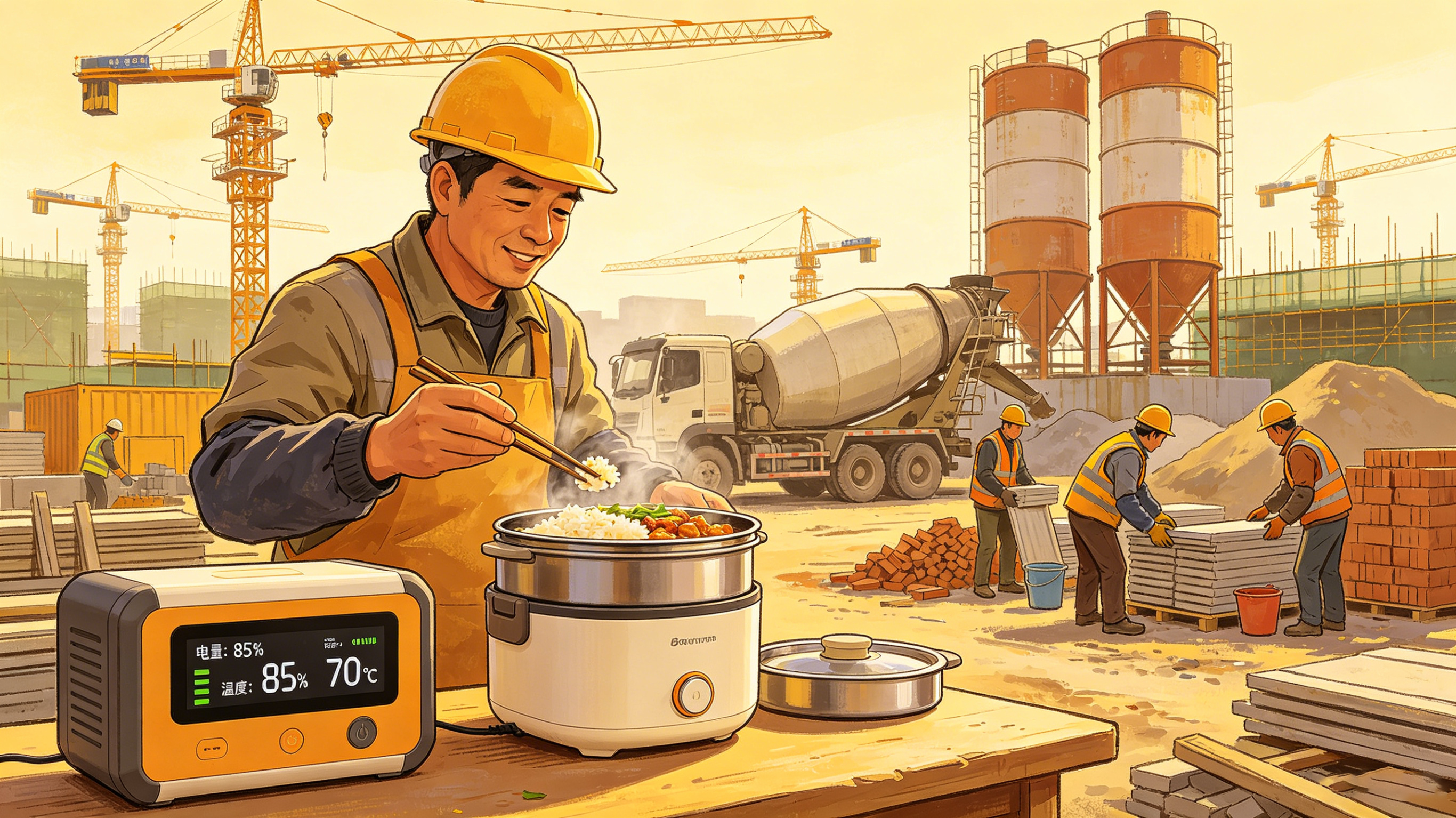
Outdoor field workers often lack convenient food heating solutions
Introduction: A Real Daily Problem Became a Product Opportunity
For many tradespeople in North America, especially carpenters, installers, and field workers, lunch is often treated as an afterthought. Their job sites change frequently, sometimes across cities and even across provinces. They carry multiple tool bags every day, work long hours outdoors, and often do not have convenient food storage or heating options.
This customer, a North American carpenter with a strong interest in DIY electronics, faced exactly that kind of problem. Every morning, his wife prepared breakfast and packed lunch for him before he left for work. But because of the nature of his job, he often became so focused on work that he forgot to eat on time. His wife cared deeply about his health and would even set reminders and call him to make sure he stopped working long enough to eat.
The problem became more serious during hot weather. One day, the lunch she had carefully prepared seemed to spoil slightly in the heat. After eating it, he developed stomach issues that affected both his health and his work. After that, his wife started choosing foods that could tolerate temperature changes better, but those meals were less fresh and less enjoyable. Over time, this began to affect his eating habits and overall physical condition.
When he discussed this with friends, he discovered that many people in similar professions had the same problem. That was when he started thinking: Could there be a better lunch box solution for people who work on the road?
1. The Customer’s Original Challenge
This was not simply a “lunch box insulation” issue. It was a real field-use problem shaped by daily work conditions.
1.1 Meals could not always be eaten on time
As a carpenter, he often worked across cities or provinces, with changing schedules and unpredictable workloads. Lunch time depended on the job, not on the clock.
1.2 Food quality was affected by weather
In summer, food could spoil in the heat. In winter, meals became cold long before lunchtime. Either way, the eating experience suffered.
1.3 Carrying extra appliances was not realistic
At first, he considered using a portable refrigerator or a car fridge together with a heating appliance such as a microwave-like device. But in reality, he already had too many tools and too much equipment to carry every day. Adding more bulky devices was simply not practical.
1.4 Traditional insulation was not enough
He also tried using better insulation materials in the lunch box. This worked reasonably well in warm weather if he ate on time, but in winter the food was still cold. It did not solve the real problem.

Portable heated lunch box designed for outdoor and mobile workers
2. How the Product Idea Took Shape
Because he was also interested in DIY electronics, he did not stop at the problem. He started building.
2.1 First prototype: plug-in heated lunch box
His first idea was to add a heating module to the bottom of the lunch box. The early prototype was designed for indoor plug-in use. It heated food quickly and performed well. He even made several units for friends, and the feedback was very positive.
2.2 The next question changed everything
Then one of his friends asked a much more important question: “Can this heated lunch box work without plugging in? I often work in remote areas where there is no power nearby.”
That question shifted the product from a simple plug-in solution to something much more valuable: a portable, battery-powered heated lunch box that could be used anywhere.
3. Why the Customer Needed a Custom Battery Solution
Once the customer decided to integrate a battery into the lunch box, the project moved into a new stage.
3.1 The heating module was available, but power matching was critical
After sourcing a suitable DC heating module, he found that in order to heat food to around 80°C within about 10 minutes, the battery had to deliver stable and properly matched output. After testing, he determined that 7.4V was the most suitable voltage platform for the heating system. At this voltage, the heating performance was more stable and the heat distribution was more even.
3.2 Runtime had to be practical for daily use
He did not want users to feel forced to recharge the lunch box every single day before leaving home. The product needed to offer practical working time and reduce charging inconvenience.
3.3 The battery had to fit inside a limited lunch box space
Unlike industrial equipment, a lunch box has very limited internal space. The battery pack needed to balance capacity, output, size, and safety within a compact structure.
Compact custom lithium battery pack for portable heating devices
4. How PKCELL Supported the Solution
After understanding the customer’s heating requirements, space limitations, and safety expectations, PKCELL provided a battery solution better suited to real product development and future mass production.
4.1 A 7.4V battery platform was selected
Based on the heating module’s working characteristics and the customer’s testing results, the battery system was designed around a 7.4V platform. This voltage offered a good balance between heating speed, output stability, and even food warming performance.
4.2 PKCELL proposed a 2S4P battery pack design
To match the lunch box dimensions and extend usable operating time, PKCELL provided a 2S4P battery pack solution. This configuration helped achieve several goals at once:
- meet the voltage requirement of the heating module
- support longer usable runtime
- fit within the limited lunch box structure
- leave room for future product optimization and production design
4.3 Additional safety design with PTC and NTC
Because this product would be used around food, in vehicles, on worksites, and under varying environmental conditions, battery safety was a critical concern. To improve the safety of the pack, PKCELL added PTC and NTC protection components to help prevent overheating-related risks and improve the overall reliability of the battery system. This meant the battery pack was not only designed to power the heater, but also to provide a higher level of protection in abnormal temperature conditions.
4.4 Preparing for certification and commercialization
As the product moved from prototype to a real commercial product, the customer also planned for higher safety and compliance standards. To ensure reliable performance under demanding conditions, the product would need to work toward UL62133 certification, especially for the North American market. That marked the transition from a DIY concept to a serious consumer product ready for large-scale commercialization.
5. What Value This Solution Brought to the Customer
5.1 It turned a personal pain point into a real product
What started as a daily lunch problem became a meaningful product idea with clear market value.
5.2 It made off-grid food heating possible
With battery support, the lunch box no longer depended on wall power. It became a truly portable heating solution suitable for remote jobsites, field work, and mobile work environments.
5.3 It created a clear product differentiation
A normal lunch box only stores food. An insulated lunch box only slows down heat loss. This product went further by solving the much more important problem of reheating food in the field. That made it much more appealing to workers, tradespeople, and users who spend their day away from traditional indoor spaces.
5.4 It created a strong foundation for product upgrades
Because the product already integrated both heating and battery functions, the customer was able to plan the next generation with additional smart features, including:
- smart heat retention
- meal-time reminder functions
This means the product is evolving from “portable heated lunch box” into a smarter daily-use food solution.
6. The Result: From Prototype to Market Recognition
After development, the product received strong market interest and went on to win multiple product design awards. That recognition did not happen by accident. The product succeeded because it addressed a real, recurring, and overlooked problem faced by many working professionals.
After launch in North America, the heated lunch box was well received by the market. The logic behind that success was simple:
- it solved a real problem
- it served a user group often ignored by mainstream consumer brands
- it was designed from field experience, not from abstract concept alone
Today, the customer is already preparing the next phase of growth, including plans to launch a new generation with smarter features and to lease warehouse space in Europe for larger-scale product distribution.
7. What This Case Shows
This project is a strong example of how product innovation often begins with a very practical everyday problem.
It also shows that for portable heating products, the battery is not just a supporting part. It is a core part of whether the product can truly work in real-life conditions.
In this project, the battery solution directly affected:
- heating stability
- runtime performance
- product size and internal layout
- safety design
- certification readiness
- long-term commercialization potential
From the selection of the 7.4V platform, to the 2S4P battery pack structure, to the inclusion of PTC and NTC safety protection, PKCELL helped transform the customer’s idea into a product with real market value.
Conclusione
This project was about far more than building a battery pack for a heated lunch box. It was about helping a customer turn a real field problem into a successful product — one that supports healthier eating, better daily convenience, and a more practical lifestyle for workers constantly on the move.
For portable heating devices like this, the battery does not simply provide power. It determines whether the product can truly deliver stable heating, practical runtime, safety, and scalability.
If you are developing a similar product — whether it is a heated lunch box, portable food warmer, off-grid heating device, or another compact consumer appliance — PKCELL can help provide a battery solution tailored to your voltage, runtime, size, safety, and certification requirements.
FAQ
Q1: What voltage battery is used for the portable heated lunch box?
A1: The solution adopts a 7.4V battery platform, which ensures stable output and even heating effect for the food warming module.
Q2: What is the battery pack configuration for this product?
A2: PKCELL designed a 2S4P lithium battery pack, which balances compact size, long runtime and stable power output.
Q3: What safety protections are equipped on the battery?
A3: The battery pack is added with PTC and NTC protection components to effectively prevent overheating risks and improve overall safety.
Q4: What certification does the product target for the North American market?
A4: The product is developed to meet UL62133 certification standards, meeting safety compliance requirements for commercial sales in North America.
Q5: What are the core advantages of battery-powered heated lunch boxes?
A5: It realizes off-grid portable heating, no need for wired power supply, suitable for outdoor jobsites, mobile work and remote areas, with reliable safety and long service life.
Keywords & Tags
7.4V Lithium Battery Pack
2S4P Battery Solution
Portable Food Warmer
PTC NTC Safety Protection
UL62133 Certified Battery
Outdoor Worker Appliance
Custom Lithium Battery
“`