
48V Drawer-Type Battery Platform for Agricultural Robots
How PKCELL Supported an AI Robotics Customer Moving Toward Commercial Orders

Automated agricultural robots bring new demands for stable outdoor power platforms
Introduction: Customer Background and Project Challenge
As AI and automation continue to reshape modern agriculture, more and more robotic equipment is moving beyond prototype development and into early commercial deployment. For OEMs in this field, the key challenge is no longer only whether the robot can operate in the field, but whether the product can scale, adapt to different applications, and support future commercialization across multiple markets.
This case comes from an agricultural AI robot manufacturer that is already entering the early stage of commercial expansion. The customer was developing a robotic platform for outdoor agricultural use and needed a battery solution that could support not only current field operation, but also future product scaling, maintenance efficiency, and market growth. For this customer, the battery was not just a power source. It was an essential part of the machine platform.
The customer is developing agricultural robots for global applications and requested a 48V LiFePO4 battery platform designed for outdoor robotic systems. Instead of asking for only one battery pack, the customer planned the project around a scalable product concept with multiple capacity options:
- 48V 45Ah
- 48V 60Ah
- 48V 100Ah
- 48V 200Ah
At the same time, the project introduced several core engineering challenges: unified 48V system architecture, drawer-type bottom-mounted battery structure, strict mounting dimension standards, CAN intelligent communication, and stable performance under complex outdoor farm environments. This turned the demand from a single battery order into a full platform integration project.
1. Key Technical Requirements
1.1 Unified 48V Architecture
The customer defined the whole machine working platform at 48V, with maximum charging voltage 54.75V and discharge cut-off voltage 37.5V. The robot power drive and control system were fully built around this voltage system, requiring PKCELL to develop a standardized, expandable 48V battery platform instead of a one-time customized pack.
1.2 Multiple Capacity & Current Matching
Four capacity specifications cover different robot models and endurance needs, with matched continuous discharge current standards:
- 45Ah: 45A continuous discharge
- 60Ah: 60A continuous discharge
- 100Ah: 100A continuous discharge
- 200Ah: Dual 100A parallel output
Drawer-style metal casing battery for agricultural robot chassis installation
1.3 Drawer-Type Bottom Installation Structure
The core structural feature of the project is a drawer-style battery mounted on the robot chassis bottom, bringing convenient installation, quick replacement and easy field maintenance. Strict mechanical limit standards are defined:
- 200Ah version width limit & 540mm mounting hole spacing
- 45/60Ah: 270W × 420L mounting hole layout
- M10 loose hole fixing design
1.4 Standardized Charging & Discharging Interfaces
Clear industrial connector configuration for farm field operation:
- Anderson 120A high-current power plug, 50cm exposed cable
- Separate charge & discharge ports
- Standard charging: IEC C14; Fast charging: M8 interface
1.5 CAN Intelligent Monitoring Communication
500Kbps CAN bus system with 4-pin M12 communication interface (CAN_H, CAN_L, Power+, GND), supporting real-time upload of SoC, total voltage, working current and temperature data. The 60Ah model is equipped with an external battery status display for on-site visual inspection, realizing whole-machine intelligent energy management and fault diagnosis.
1.6 Wide Outdoor Temperature Adaptation
Farm scenarios involve large temperature fluctuations day and night, with official operating standards:
- Charging temperature: 0°C ~ 45°C
- Discharging temperature: -20°C ~ 60°C
- Long-term reserve wide temperature range: -40°C ~ 85°C for global multi-climate market expansion
2. Why The Customer Needed A Complete Battery Platform
The customer’s core demand is not a single battery pack, but a reusable energy platform supporting full product series iteration, which can realize unified installation standards, rapid after-sales replacement, and cross-regional climate adaptation, laying hardware foundation for mass commercial orders in Australia, the US and large agricultural markets.
A platform-type battery solution supports multi-model robot iteration, standardized maintenance, intelligent fleet management and long-term outdoor reliability, turning prototype R&D into mass-production ready products.
3. PKCELL Platform Solution Direction
3.1 Unified 48V LiFePO4 Series Platform
Realize shared structural design, BMS control logic and communication protocol across 45Ah-200Ah four capacity specifications, greatly shortening new model development cycle and reducing mold and verification costs for the robot manufacturer.
3.2 Rugged Metal Enclosure Chassis Integration
Metal shell structure enhances dustproof, waterproof and anti-vibration performance, adapting to complex farm conditions such as mud, dust and strong sunlight, perfectly matching drawer bottom mounting layout.
3.3 Drawer Structure Optimized For Field Service
Plug-and-play drawer design greatly improves maintenance efficiency. Field technicians can complete battery replacement without disassembling the whole robot, reducing farm downtime during continuous operation seasons.
3.4 Full CAN Intelligent Monitoring System
The battery pack becomes a core control subsystem of the robot, realizing real-time power monitoring, abnormal alarm and big data logging, supporting later fleet remote management for large-scale agricultural operators.

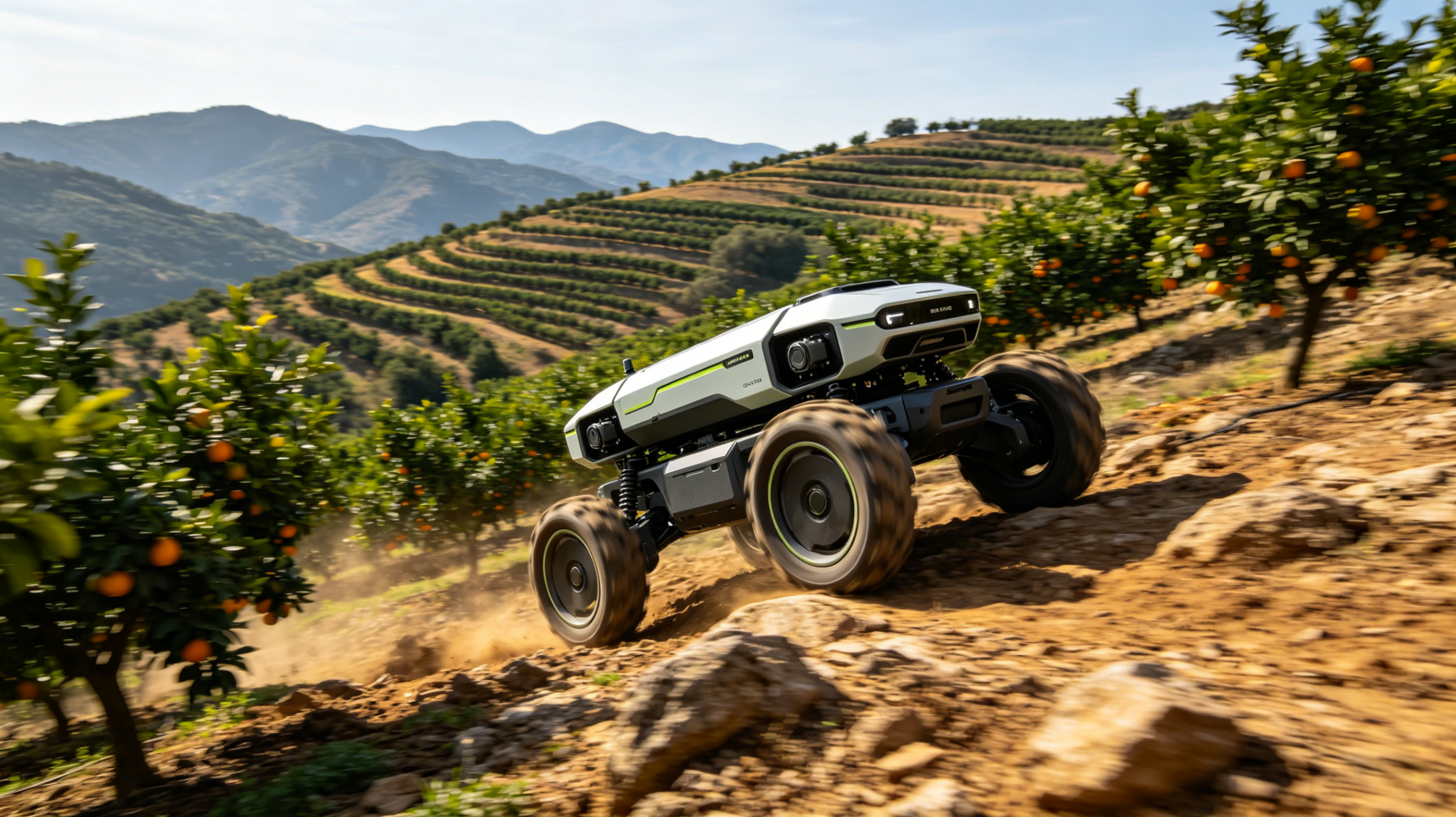
Commercial agricultural robot equipped with PKCELL 48V drawer battery platform
4. Current Project Status & Market Next Steps
The robot’s shell, motor power system and all mechanical structures have been finalized. The only remaining core verification work is the full test of the 48V drawer battery platform. After battery performance, communication and environmental aging tests are completed, the customer will launch complete product promotion to overseas large agricultural markets including Australia and United States, targeting bulk commercial purchase orders.
This project has crossed the prototype verification stage and entered the pre-mass-production preparation phase, where the standardized battery platform is the key finishing component for market landing.
5. Core Commercial Value Of This Battery Platform
This case fully demonstrates how battery planning determines the upper limit of robot commercialization capacity, bringing multiple core values to agricultural equipment OEMs:
- Support multi-model product series scalable iteration
- Simplify field maintenance and battery replacement workflow
- Realize CAN intelligent linkage with robot control system
- Stable performance under all-day outdoor farm environment
- Meet multi-climate global market deployment standards
- Shorten product launch cycle for overseas bulk orders
결론
This project is far more than a single 48V lithium battery customization project. PKCELL cooperated with agricultural robot manufacturers to build a fully scalable drawer-type LiFePO4 energy platform covering multiple capacity specifications, unified 48V voltage system, CAN intelligent communication and wide temperature outdoor adaptability.
With robot mechanical and electrical design fully finalized, battery platform verification is the last key link before market launch. Once verified, the customer can launch complete robot solutions to large agricultural markets in Australia, USA and other regions to obtain large commercial orders.
For unmanned equipment manufacturers, agricultural robot brands and outdoor automation OEMs, a well-planned standardized battery platform is not only a power supply, but the core foundation supporting long-term product iteration and global commercial expansion.
자주 묻는 질문
Q1: What battery cell type is adopted for agricultural robot 48V platform?
A1: Adopt LiFePO4 lithium iron phosphate cells, with four scalable capacity versions: 45Ah / 60Ah / 100Ah / 200Ah under unified 48V architecture.
Q2: What is the advantage of drawer-type bottom mounting battery?
A2: Easy disassembly and replacement, convenient on-site maintenance, make full use of chassis space, unify installation standards for the whole robot product line.
Q3: What communication method does the agricultural robot battery support?
A3: 500Kbps CAN bus communication via M12 interface, real-time feedback SoC, voltage, current and temperature data to robot main control system.
Q4: What temperature range can the battery work in farm outdoor environments?
A4: Discharge range -20°C~60°C, charging range 0°C~45°C, long-term wide temperature reserve -40°C~85°C adapting to global climate zones.
Q5: Which overseas markets is this agricultural robot solution targeted at?
A5: Prioritize large-scale agricultural markets such as Australia and the United States after battery platform full verification and product promotion.
Keywords & Tags
Drawer Type LiFePO4 Pack
CAN Communication Battery
Multi-Capacity Battery Platform
Outdoor Farm Power Supply
AI Robot Lithium Battery
Wide Temp LiFePO4 Battery
Unmanned Equipment Battery