
Blog
Why Does Temperature Dictate the Life of Your Battery?
3 月 20, 2026
提出免费咨询请求

Lithium-ion batteries power most of the devices we rely on today—from laptops and flashlights to electric vehicles and industrial tools. Among the many battery formats available, 18650 and 21700 cylindrical lithium-ion cells have become two of the most widely used standards in modern energy storage systems.
Although both battery types share similar chemistry and operating principles, their size, energy density, discharge capability, and real-world applications differ significantly. Understanding these differences is essential for engineers, product designers, and buyers selecting the right battery solution.
In this guide, we will compare 18650 vs 21700 batteries in detail, covering physical dimensions, capacity, performance, and ideal applications to help you determine which battery format best suits your project.
Cylindrical lithium-ion batteries follow a standardized naming convention defined by international battery standards. The numbers in the name refer directly to the physical dimensions of the cell.
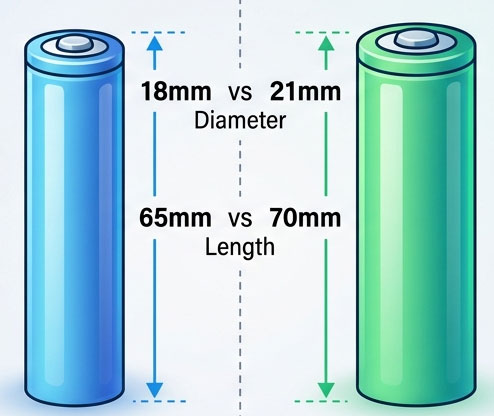
The difference may appear small at first glance, but the additional diameter and length of the 21700 battery result in significantly greater internal volume.
In fact, a 21700 cell offers approximately 47% more internal space than an 18650 cell. This extra space allows manufacturers to pack more active electrode material into the battery, which increases the amount of energy that can be stored.
Inside each cylindrical battery is a tightly rolled structure known as the “jelly roll,” consisting of the cathode, anode, separator, and electrolyte. The larger casing of the 21700 allows for a bigger jelly roll, directly contributing to improved energy storage capacity.
One of the most important differences between the two formats is battery capacity.
Typical capacities include:
| 电池类型 | Typical Capacity Range |
|---|---|
| 18650 | 2,300 mAh – 3,600 mAh |
| 21700 | 4,000 mAh – 5,000 mAh |
This means that, on average, a 21700 battery can store 25–35% more energy than a comparable 18650 cell.
Higher energy density provides several advantages:
For example, electric vehicle battery packs that previously required thousands of 18650 cells may use fewer 21700 cells while achieving similar or better performance.
The move toward higher-capacity cylindrical cells reflects a broader trend in battery engineering: maximize energy storage while reducing system complexity.
Another critical factor when comparing 18650 vs 21700 batteries is discharge capability, which determines how much current a battery can safely deliver.
Typical discharge performance:
| Feature | 18650 Battery | 21700 Battery |
|---|---|---|
| Continuous Discharge | 10A – 30A | 20A – 45A+ |
| Peak Discharge | Higher in specialized cells | Higher overall capability |
| Thermal Stability | Good | Improved due to the larger surface area |
The larger structure of the 21700 battery allows it to handle higher current output with better heat dissipation. More internal surface area means heat generated during high-drain operation can spread more effectively throughout the cell.
This is particularly important in applications such as:
Higher discharge capability allows devices to deliver stronger bursts of power without damaging the battery.
Weight is another factor engineers must consider when choosing between these battery formats.
Typical weights:
| 电池类型 | Average Weight |
|---|---|
| 18650 | 45g – 48g |
| 21700 | 65g – 70g |
Although the 21700 battery is heavier, it stores significantly more energy per cell, which often results in a better energy-to-weight ratio at the system level.
For example, instead of using ten 18650 cells, a battery pack might only require seven or eight 21700 cells to achieve the same capacity. This can reduce wiring complexity, improve reliability, and simplify battery management systems.
However, in applications where every gram matters, the lighter 18650 cell may still be preferred.
Despite the growing popularity of the 21700 format, the 18650 battery continues to dominate many industries.
Several factors explain its long-standing success.
The 18650 battery has been produced for decades, resulting in a highly optimized manufacturing supply chain. Major battery manufacturers have invested heavily in production lines specifically designed for this format.
Because of this, 18650 cells are widely available and often more cost-effective than newer battery formats.
Many products—especially those designed in the past 10–15 years—were engineered specifically around the dimensions of the 18650 battery. Switching to a larger battery format would require redesigning internal layouts, housings, and cooling systems.
Devices that commonly use 18650 batteries include:
In equipment such as drones, headlamps, and handheld tools, even a small weight difference can affect comfort and performance. Because each 18650 cell weighs roughly 20 grams less than a 21700 cell, designers may choose it for applications where weight reduction is critical.
While the 18650 format remains important, the 21700 battery is rapidly becoming the preferred choice for high-performance systems.
One of the biggest drivers of its popularity was its adoption by Tesla in the Tesla Model 3 and Tesla Model Y.
By switching to the 21700 format, Tesla was able to improve battery pack efficiency and reduce manufacturing complexity.
Because each cell stores more energy, fewer cells are required to achieve the same battery pack capacity. This simplifies battery pack design and reduces internal electrical connections.
The larger cylindrical structure helps distribute heat more evenly during charging and discharging. This contributes to improved safety and stability during high-power operation.
Higher-capacity cells often operate under lower relative stress in many applications. Instead of pushing smaller cells to their limits, systems using 21700 batteries may run at lower current percentages, which can extend cycle life.
Today, the 21700 format is increasingly used in:
As manufacturing capacity continues to expand, the cost of 21700 batteries is gradually decreasing, making them more competitive with the older 18650 format.
Selecting the correct battery format depends on several factors, including space constraints, power requirements, cost considerations, and system design.

In general, the 18650 battery remains ideal for compact electronics, while the 21700 battery is better suited for modern high-power applications.
Battery technology continues to evolve rapidly as industries demand more efficient energy storage solutions. Larger cylindrical formats, improved cathode materials, and advanced battery management systems are helping push performance to new levels.
While both battery formats will remain relevant for years to come, the growing demand for electric vehicles, renewable energy storage, and high-performance electronics is accelerating the shift toward higher-capacity cells like the 21700.
For engineers and manufacturers, the key is selecting the battery format that offers the best balance of energy density, power capability, and system efficiency.
In summary:
Understanding the differences between these two cylindrical lithium-ion battery formats can help designers and buyers make smarter decisions when developing the next generation of battery-powered technology