
From Traditional Action Cameras to Smart Ski Goggles
How PKCELL Supported an Extreme-Cold Battery Solution for a New Wearable Imaging Product

Rapidly growing winter sports market brings demand for smart ski recording equipment
Introduction: A New Idea Born from the Rise of Skiing in China
As skiing has grown rapidly in China in recent years, more and more winter sports enthusiasts have wanted to record their first-person experience on the slopes. In the past, most people used handheld action cameras or mounted cameras on their helmets. While these methods could capture footage, they also created obvious drawbacks.
For skiers, handheld cameras interfere with balance and movement, while helmet-mounted cameras add weight and can increase risk during high-speed turns, jumps, or falls. In a sport where safety, agility, and field of vision are critical, any extra external device can become inconvenient or even dangerous.
Against this background, a Chinese customer proposed a more natural and sport-friendly idea: Integrate a camera directly into ski goggles.
This concept was simple, but highly practical. Ski goggles are already essential equipment for skiers. By integrating a camera into the goggles, the product could reduce the burden of carrying an extra recording device while capturing footage from a more natural perspective. Because the camera follows the skier’s line of sight, it can record the ride more intuitively and allow users to enjoy skiing while safely capturing the moment.
However, once the concept moved into product development, one major challenge quickly emerged: Could the battery still support stable video recording in extreme cold?
Unlike standard consumer electronics, ski goggles are used in naturally cold and often extreme environments. The customer set very demanding battery requirements:
- At -40°C, the device had to remain operational in half-power mode, supporting normal video capture such as lower frame rate, medium-quality recording
- At -20°C, the device had to support full-power operation, including 4K / 8K 60fps action footage recording
This meant the battery solution had to meet much more than basic power supply needs. It had to balance low-temperature discharge capability, peak output, runtime, space limitations, and wearing comfort. For a face-worn product like ski goggles, the battery could not be too large or too heavy, and it could not lose core functionality simply because the temperature dropped. That is where PKCELL came in.
1. The Real Problem the Customer Wanted to Solve
For skiers, the goal was not simply to “record video.” The real goal was to make recording safer, more natural, and more practical in actual skiing conditions.
1.1 Traditional recording methods were not ideal
Handheld action cameras reduced convenience and affected movement. Helmet-mounted cameras created extra bulk and could increase safety risks during intense motion.
1.2 Users wanted a more natural first-person perspective
A camera integrated into ski goggles allows the recording angle to move more naturally with the skier’s gaze, creating footage that feels more immersive and true to the real experience.
1.3 The product had to remain lightweight and comfortable
Ski goggles sit directly on the face and head, so overall weight, size, and comfort are essential. The battery solution had to fit within a compact wearable product without compromising the user experience.
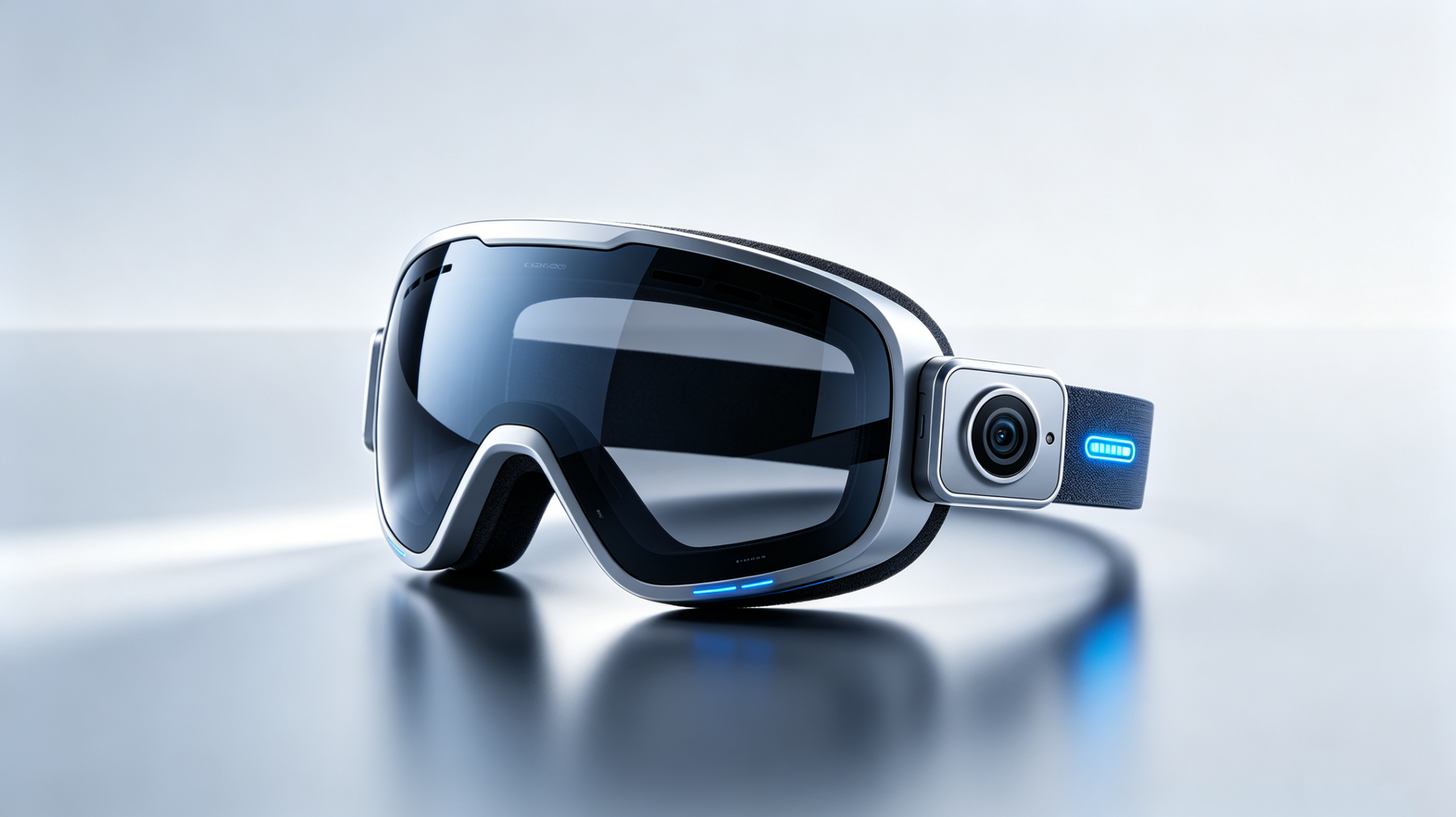
Smart ski goggles with built-in first-person recording camera
2. Why the Battery Became the Key to the Entire Product
Once the optical and imaging concept was defined, the customer realized that the main challenge was no longer just the camera module itself. The key question became: Can the battery continue to deliver enough power under extreme cold conditions, and can it support different recording modes at different temperatures?
2.1 Working at room temperature is not enough
Many devices perform well indoors or in standard environments, but skiing takes place in snowfields, mountains, and cold wind. If the battery output drops too much at low temperature, high-performance recording functions may fail when they are needed most.
2.2 Different operating modes require different power capability
The customer’s demand was not simply “the device must turn on.” The product needed to support two very specific scenarios:
- At -40°C: half-power mode, enough for standard recording with lower frame rate and medium image quality
- At -20°C: full-power mode, supporting 4K / 8K 60fps high-spec action video
So the battery solution had to be matched not only to the hardware, but also to different cold-weather operating conditions.
3. How PKCELL Supported the Project
To meet these requirements, PKCELL provided a battery pack solution specifically matched to the customer’s product structure, low-temperature use case, and imaging power demand.
3.1 Battery pack configuration
The project used a battery pack based on:
- LP702937-800mAh 2P
- Total capacity: 1600mAh
- Nominal voltage: 3.85V
This was not just a battery that fit physically inside the product. It was a power solution selected to create a practical relationship between low-temperature discharge capability and the device’s actual operating current.

LP ultra-thin Li-Po battery for cold-resistant smart wearable eyewear
3.2 Low-temperature discharge performance matched to device power demand
The customer’s device has a full-power operating current of approximately 550mA.
The PKCELL battery pack provided the following low-temperature discharge capability:
- At -40°C: approximately 320mA discharge
- At -20°C: approximately 800mA discharge
This created a clear and practical power-matching result:
- At -40°C, the pack can support the device in half-power mode, which aligns with the customer’s requirement for normal low-frame-rate, medium-quality video recording
- At -20°C, the battery pack’s 800mA discharge capability is higher than the device’s 550mA full-power operating current, meaning it can support 4K / 8K 60fps recording under that condition
This is what makes the battery solution meaningful. It was not designed only for room-temperature specifications, but for real cold-environment use.
3.3 Compact integration for wearable comfort
Because the product is a pair of ski goggles, available space is extremely limited. The battery system had to balance energy, size, and weight carefully. PKCELL’s solution helped the customer move toward integrated imaging functionality without obviously sacrificing comfort or wearability.
4. What Value This Solution Created
4.1 It made safer recording possible during skiing
Compared with traditional action camera setups, the product no longer requires users to hold a device or add a separate external camera to the helmet. That makes recording safer and better suited to real skiing conditions.
4.2 It created a more natural first-person filming experience
Because the camera is integrated into the goggles, the footage follows the skier’s line of sight more naturally. This gives users a more immersive and intuitive recording result.
4.3 It made low-temperature recording far more practical
With the LP702937-800mAh 2P battery solution, the customer’s product is not just “camera-enabled.” It becomes a product that can operate in clearly defined cold-environment modes:
- basic recording capability at -40°C
- high-performance recording capability at -20°C
4.4 It strengthened product differentiation
As skiing continues to grow in China, users increasingly want gear that is smarter, more personalized, and more content-oriented. This product does more than protect the eyes. It combines eye protection, first-person recording, and extreme-cold adaptability in one integrated product.
5. Why This Case Is Representative
This project is a very clear example of an important reality in smart wearable product development: The battery is not a secondary component added at the end. It is one of the core foundations that determines whether the product can truly exist.
In this ski goggle project, the battery directly affected:
- whether recording could still function in low temperatures
- whether high-spec video modes could be supported
- whether the product remained lightweight enough to wear comfortably
- whether users could trust it in real ski environments
- whether the concept could realistically move toward production and commercialization
PKCELL’s value in this project was not only the specification of 1600mAh / 3.85V, but also the creation of a clear technical logic between low-temperature discharge capability and real device current demand.

Field test of smart recording ski goggles in extreme cold snow environment
6. Commercial Roadmap and Next Steps
With the product direction now clearly defined, the customer has also established a practical commercialization plan.
The first step will be to complete CCC certification in order to meet compliance requirements for the domestic Chinese market. This is a logical path, because China is both the origin of the product idea and one of the fastest-growing skiing markets, with increasing demand for smarter and more experience-oriented winter sports equipment.
By entering the Chinese market first, the customer will be able to:
- validate real market acceptance more quickly
- collect direct user feedback
- refine performance, comfort, and imaging features based on actual usage
- build an initial brand and product foundation in a familiar market
After establishing a stronger position domestically, the customer plans to gradually expand into European and North American markets. These regions already have mature skiing and snowboarding industries, and a product that combines safer recording, first-person visual capture, and strong low-temperature battery performance has clear market potential there as well.
The roadmap is therefore very clear:
- Stage 1: Complete CCC certification and enter the domestic Chinese market
- Stage 2: Continue product refinement based on real local user feedback
- Stage 3: Expand into Europe and North America to build international market share
This path moves the product from concept validation toward a more standardized, compliant, and internationally scalable business model.
總結
This customer did not simply add a camera to a ski goggle. He rethought how skiers could capture their experience in a way that is safer, more natural, and better aligned with real use on the mountain.
By supporting the project with a custom battery pack solution based on LP702937-800mAh 2P, 1600mAh, 3.85V, and by matching 320mA discharge capability at -40°C and 800mA discharge capability at -20°C to the product’s actual operating modes, PKCELL helped move a strong concept closer to real commercialization.
With the customer’s full-power current at approximately 550mA, the battery solution clearly supports the product’s high-performance imaging requirement at -20°C, while still maintaining practical half-power recording capability at -40°C.
At the same time, the customer has already defined a realistic market strategy: first complete CCC certification and serve the Chinese domestic market, then gradually expand into Europe and North America.
For brands and product teams developing ski gear, action-imaging products, smart eyewear, or other cold-weather wearable electronics, this case shows that true innovation is not only about product design. It is also about solving the power challenge under real environmental conditions and aligning the solution with a practical certification and market-entry roadmap.
常見問題
Q1: What battery model is customized for smart ski goggles?
A1: Adopt LP702937-800mAh 2P Li-Po pack, total capacity 1600mAh, nominal voltage 3.85V, ultra-thin design to fit goggle internal space.
Q2: What discharge performance can the battery achieve at ultra-low temperature?
A2: 320mA stable output at -40°C for half-power recording; 800mA output at -20°C to support full-spec 4K/8K 60fps video recording.
Q3: Why is built-in camera ski goggle better than helmet action cameras?
A3: No extra weight on helmet, shooting angle follows human sight, safer during skiing jumps and high-speed turns, more lightweight and portable.
Q4: What certification will the smart ski goggle obtain first?
A4: Prioritize CCC certification to meet China domestic market access standards, then expand to EU and North American markets later.
Q5: What products are this wide-temperature Li-Po battery suitable for?
A5: Smart ski eyewear, cold-resistant wearable cameras, winter sports electronics, outdoor low-temperature recording wearables and other compact wearable devices.
Keywords & Tags
-40°C Low Temp Li-Po Battery
1600mAh 3.85V Battery Pack
LP702937 Li-Polymer Cell
Wearable Camera Power Supply
Winter Sports Electronics Battery
4K Recording Wearable Battery
Custom Ultra Thin Battery