
Solution of From Loss on Everest to a Heated Vest for Extreme Cold
How PKCELL Helped Support a Wearable Heating Solution for Mountaineers in Harsh Alpine Environments
Introduction: A Tragedy That Became the Beginning of a Product
This customer was not only an experienced mountaineer but also a recognized leader in the climbing community. In his early thirties, he had already summited several of the world’s highest peaks. As secretary-general of a mountaineering association, he actively organized climbing activities and patiently shared safety guidance with new members.
But the moment that changed his direction came in 2003. That year, he and one of his longtime friends set out to climb Mount Everest. They had trained for a long time and prepared carefully for the expedition. Even so, disaster struck. At close to 7,500 meters, temperatures dropped sharply, and his friend developed severe hypothermia. After going to sleep that night, he never woke up.
The loss left the customer devastated. For months, he blamed himself, replaying the moment they had set out together and wondering whether one more reminder about wind protection or thermal gear might have changed the outcome. He withdrew from mountaineering activities for nearly half a year.
But out of that grief came a question that would later become a product: When hypothermia happens in the mountains, is there a better way to provide sustained, controllable, and repeatable heat support?

1.The Real Problem He Wanted to Solve
For mountaineers, the danger is not simply feeling cold. The real danger is how quickly core body temperature can drop under the combined effect of altitude, wind, exhaustion, and exposure.
1.1 Emergency heat patches are only a temporary measure
There are chemical heat packs on the market that can help in emergencies, but in his view they still had major limitations:
- heat duration is limited
- heat output is difficult to control
- heating distribution is uneven
- they are not ideal for helping the upper body recover temperature quickly after severe cold exposure
1.2 Extreme environments require active heat, not only passive insulation
In high-altitude conditions, jackets and insulation layers alone may not be enough once hypothermia begins. What he wanted was a more active solution — one that could provide sustained, more uniform heat to the torso and help the body recover faster.
1.3 Any solution had to remain lightweight
This was critical. Climbers care deeply about weight. Even if a product works well, it will not be accepted if it is too bulky or too heavy. The final solution had to be both effective and wearable.
2. How the Product Evolved
The customer did not begin with a battery-powered idea right away.
2.1 First concept: chemical reaction heating inside clothing
His first approach was to integrate reactive materials into clothing. He experimented with iron powder, activated carbon, vermiculite, water, and inorganic salts, and added an air valve switch. Once the valve opened, oxygen would react with the materials and release heat inside the garment.
The idea worked in principle and could generate warmth.
2.2 The first design had one major limitation
The problem was that the reaction was not reversible. That meant the product was essentially single-use. For real mountaineering applications and broader commercial potential, that was not enough.
2.3 Second-generation idea: heating film plus battery
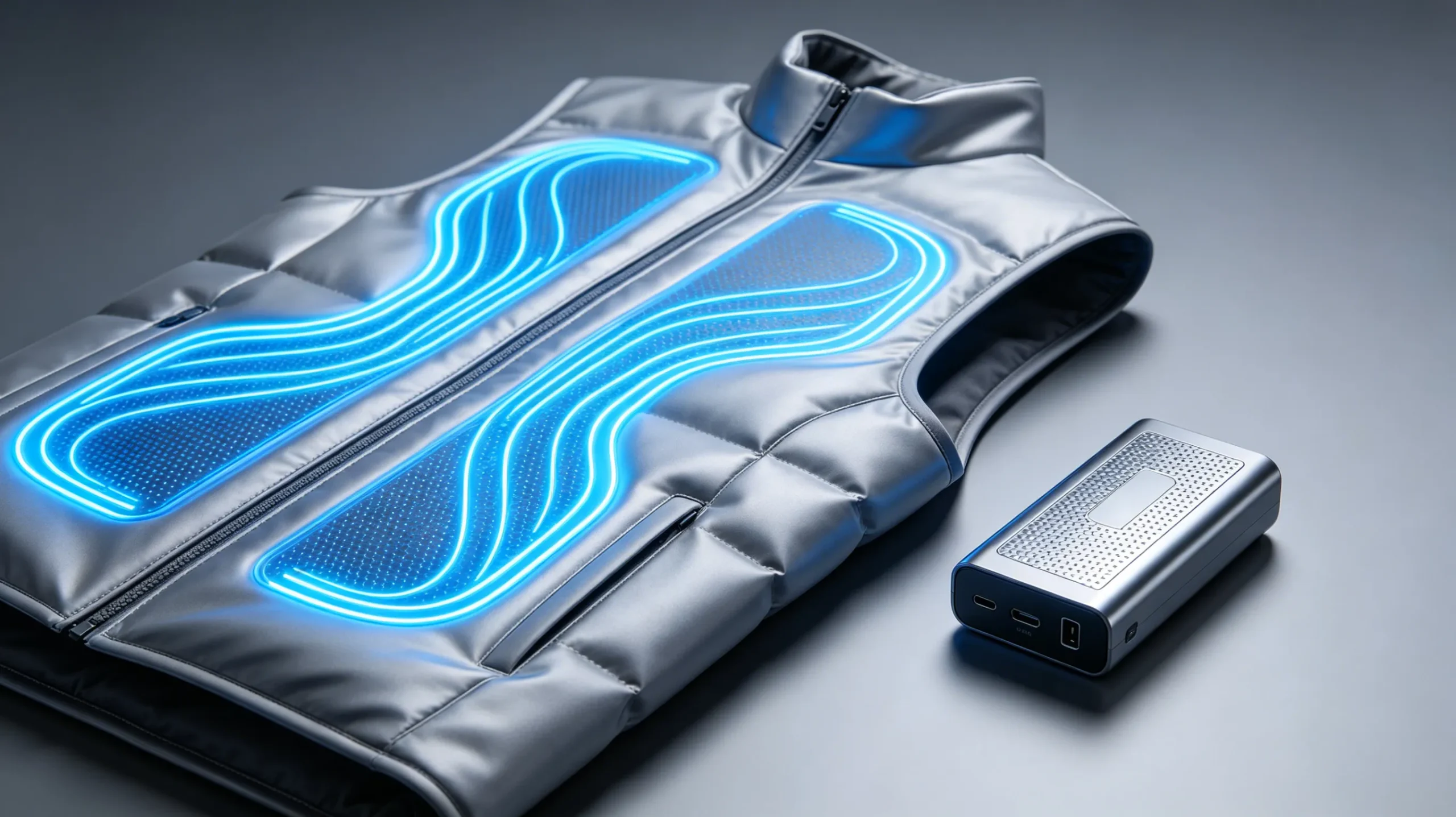
He then moved to a much more practical concept: using a heating film distributed across most of the vest area and powering it with a rechargeable battery.
This approach offered clear advantages:
- rechargeable and reusable
- more controllable heat output
- more even heat distribution
- better suited for repeated expeditions
- more realistic for product development and future scaling
Instead of making a heavy heated jacket, he chose a heated vest platform. Its light weight and wearability later became one of the main reasons many mountaineers were drawn to the product.
3. Why a Custom Battery Solution Was Essential
Once the heating-film concept was defined, the next challenge became obvious: What kind of battery can still support heating performance in severe cold?
3.1 Standard batteries are often not enough in alpine cold
For mountaineering and high-latitude applications, the battery must do more than store energy. It has to continue delivering stable output in low-temperature environments. Otherwise, even a well-designed heating garment may fail when heat is needed most.
3.2 The system had to remain light and wearable
Because the final product was a vest, the battery system could not be heavy or oversized. The pack had to support thermal performance without compromising comfort and freedom of movement.
3.3 Climbers need clear battery visibility before departure
In mountaineering, it is difficult to recharge once the journey begins. That makes pre-departure battery checking extremely important. Users need a quick and reliable way to know whether the battery is ready.
4. How PKCELL Supported the Project
After understanding the customer’s needs — low-temperature operation, wearable integration, safety, and practical field use — PKCELL supported the project with a battery direction more suitable for harsh-environment heating garments.
4.1 Wide-temperature battery support for cold-environment use
For this type of heated vest application, PKCELL / PKNERGY supported the project with a wide-temperature battery solution direction aimed at cold-weather reliability.
According to PKNERGY’s internal technical materials, the company supports custom battery development covering voltage range, capacity configuration, form factor, BMS integration, and temperature-performance customization, as well as real-time monitoring, CAN / RS485 protocol support, and data logging through the BMS platform.
4.2 Low-temperature validation and extreme-environment upgrade path
For cold-weather applications, the project also benefited from PKNERGY’s internal low-temperature verification route. In the company’s March 2026 low-temperature traceability material, a related 18650 lithium-ion battery pack with BMS was validated at -20°C, 80% charge, and 0.5C continuous discharge, where the pack maintained sufficient voltage for the specified load condition. The same material also documents PKNERGY’s -40°C to 85°C wide-temperature customized battery pack upgrade direction for extreme environments.
For a product designed to deliver heat in alpine conditions, this kind of low-temperature battery direction was especially important.
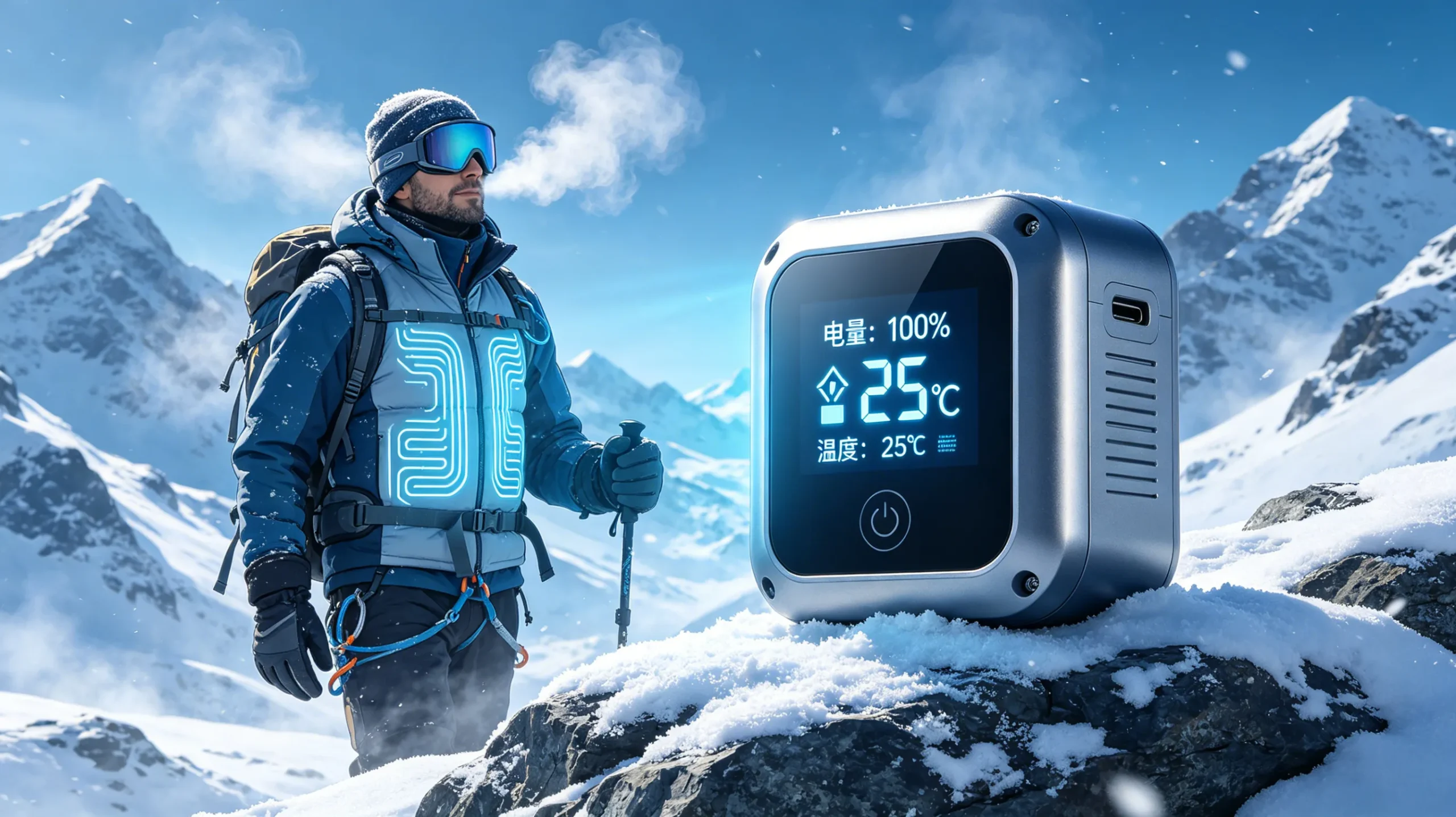
4.3 Visual battery gauge for pre-departure readiness
To improve practicality for climbers, the customer also chose a visible battery level indicator so users could check remaining capacity before departure and recharge in advance if needed.
In high-altitude use, this is more than a convenience feature. It helps reduce the risk of discovering a low battery only when heating is urgently needed.
4.4 Wearable comfort remained a priority
Because the final product was a vest rather than a jacket, the battery solution also had to support the product’s lightweight design philosophy. This balance between heating capability and wearability made the product far more attractive to actual mountaineers.
5. What Value the solution create
5.1 It transformed grief into meaningful innovation
This was not a product created for novelty. It came from a very real and painful problem: how to support body-temperature recovery more effectively when hypothermia becomes life-threatening.
5.2 It upgraded the concept from disposable heat to rechargeable heat
Compared with the early chemical-reaction concept, the heating-film-plus-battery architecture made the product:
- rechargeable
- reusable
- more stable in output
- better suited for repeated use
- much more viable for commercialization
5.3 It improved confidence in cold-weather use
By moving toward a wide-temperature battery solution, the customer gained a stronger technical foundation for high-altitude and high-latitude use. PKNERGY’s internal materials support both low-temperature discharge verification at -20°C and an engineering upgrade direction toward -40°C to 85°C wide-temperature customized packs.
5.4 The vest form factor made the product easier to accept
Instead of building a bulky heating garment, the customer chose a lighter heated vest design. That choice improved mobility, comfort, and layering compatibility, all of which matter greatly in climbing environments.
6. Commercial Direction and Next Steps
After establishing the product concept, the customer planned to move forward with IEC certification in order to improve compliance and strengthen the product’s international market position.
His goal is not limited to one climbing circle or one region. He wants to build a product that can serve mountaineers and outdoor users in cold and high-latitude regions worldwide.
That gives the project a clear future path:
- from field-driven concept to standardized product
- from mountaineering use to broader cold-weather outdoor markets
- from a functional prototype to a globally marketable technical product
7. What This Case Shows
This case is a strong example of how valuable products often begin not with “what should we invent,” but with what do real users lack in extreme conditions?
It is especially relevant for:
- heated apparel brands
- mountaineering equipment companies
- cold-weather outdoor product developers
- rescue or emergency thermal gear projects
- wearable heating systems for high-latitude markets
It also highlights a key point: For low-temperature wearable products, the battery should never be treated as an afterthought. It is central to whether the product can work reliably when conditions are most demanding.
Conclusione
For wearable heating products in extreme environments, the battery is not just a supporting component. It directly affects: whether heating can start when needed; whether the system can keep operating in the cold; whether the user can verify battery readiness before departure; whether the garment remains lightweight and wearable; whether the product can move toward real commercialization.
From a tragic Everest experience, to a first-generation chemical-heating concept, to a rechargeable heated vest supported by a low-temperature battery direction, this project represents a full journey from real pain point to meaningful product solution.
If you are developing heated apparel, cold-weather wearable systems, or battery-powered products for extreme outdoor environments, PKCELL can support you with custom battery development based on your target temperature range, heating power, wearability requirements, runtime goals, and certification path. PKNERGY’s current internal materials support a clear external-facing position around custom battery design, BMS integration, low-temperature discharge capability, and wide-temperature solution development for extreme environments.
FAQ
Q1: Why can’t ordinary batteries be used for heated vests in high mountains?
A1: Standard batteries suffer severe capacity drop and unstable discharge at low temperatures. Wide‑temperature batteries from PKCELL maintain stable output even at −20°C and support upgrade to −40°C to 85°C for extreme alpine environments.
Q2: What are the advantages of the battery solution for heated vests?
A2: It supports low‑temperature discharge, lightweight design, visible power indication, BMS protection, and customizable voltage/capacity to fit wearable heating systems.
Q3: Can the heated vest battery be reused and recharged?
A3: Yes. The solution uses rechargeable lithium‑ion battery packs, which support hundreds of cycles and are ideal for long‑term mountaineering and outdoor use.
Q4: Does PKCELL provide low‑temperature test data for heated clothing batteries?
A4: Yes. Internal test reports validate stable discharge at −20°C, 0.5 °C, with complete BMS performance and no abnormal protection trigger.
Q5: Can the battery be customized for different heated vest designs?
A5: Yes. PKCELL supports customization in voltage, capacity, shape, interface, BMS, and temperature range to match various wearable heating products.
Keywords & Tags
Low Temperature Battery
Wearable Heating Battery
Wide Temperature Battery Pack
Mountaineering Heating Battery
Rechargeable Heated Vest
BMS for Wearable Battery
Outdoor Extreme Cold Battery